
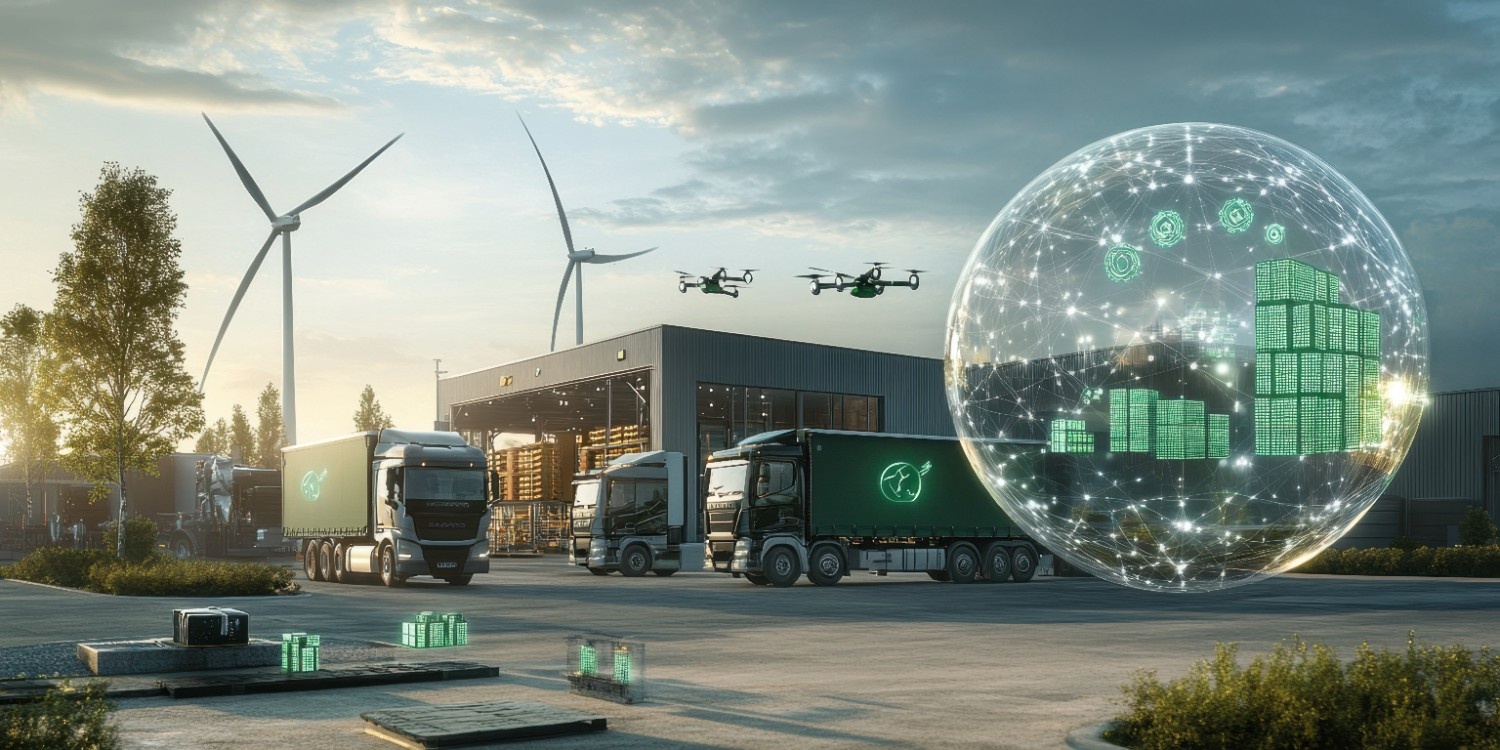
Sustainability is no longer a tender, warm concept in logistics, but a business necessity. In 2025, businesses are realizing that it is not only about saving the planet, but also about going green. It is all about saving, being competitive, and satisfying the requirements of more aware consumers. From electric fleets to AI carbon tracking, Logistics is finally being redefined, with a fundamental shift in profitability and responsibility finally coming together.

The Pull Towards Greener Logistics
Logistics has never been an easy endeavor to undertake, the coordination of millions of shipments across borders, ports, warehouses, and vehicles that never sleep. That scale also makes it one of the world’s largest polluters. The Green Logistics Industry Outlook 2025 revealed that nearly a tenth of the world’s CO2 emissions are attributable to logistics operations and that companies need to reconsider the way they transport products.
This reevaluation is causing a revolution. The green logistics market is expected to grow at a 6.8% CAGR to reach an estimated 2.1 trillion by 2034, up from its current size of 1.2 trillion, with a size of 17 billion by 2025. Why the surge? A combination of regulatory shifts, investor pressure, and consumer expectations.
Governments are increasing carbon-emission regulations, particularly in Europe, North America, and Asia. Corporate boards are incorporating ESG (Environmental, Social, and Governance) indicators into their performance scoring, and customers are voting with their wallets by choosing brands that can demonstrate their sustainability accolades.
Green Logistics as a Competitive Advantage
Logistics companies have been crazed over price and speed for decades. Sustainability is now part of that very short list. Businesses that put the environment in the core of their operations are not merely putting a box to be filled in compliance; they are hedging their future.
Here’s how:
Productivity is Equal to Profitability
Most green practices are actually cost-reducing. The route planning system saves up to 20% of fuel, and automated warehouse lighting and energy management, powered by AI, save up to 30% of electricity costs. Now, electric and hydrogen-powered fleets, which were previously viewed as costly experiments, are economically feasible. Other companies, including DHL and Maersk, have been reporting reduced maintenance and long-term fuel costs following the shift of part of their fleets to alternative power vehicles.
Winning Over Customers and Investors
Greenness draws brand loyalty. According to the recent surveys, 49% of consumers prefer environmentally friendly logistics partners at similar costs. It is also attracting the attention of investors: green-certified logistics firms in 2025 are increasingly priced more competitively and receiving better financing terms, particularly under the new EU sustainable finance rules.
Compliance Without Panic
New emission policies, such as the Carbon Border Adjustment Mechanism (CBAM), which will be initiated in the EU in 2026, punish dirty supply chains by importers. Companies in the logistics sector that ensure they are the first to act and reduce emissions through documentation avoid fines, delays, and retrofit expenses.
Technology: The Actual Sustaining Engine
This is not a green revolution in logistics driven solely by good intentions. Still, it is the power of the technology that enables the measurement of sustainability, scalability, and profitability.
AI and Machine Learning help firms predict demand, optimize loads, and reduce waste. Specifically, generative AI is being applied to model entire transport systems and test cases, such as diesel-to-hydrogen fleet switches, to understand the costs and emission impacts before rolling them out.
Energy management is undergoing a revolution with IoT and Real-Time Tracking. The sensors installed on fleets and facilities by IoT monitor energy consumption, idling, and emissions in real time. Add to this data analytics dashboards, and businesses will be able to identify areas of inefficiency and reduce carbon emissions with scalpel accuracy.
Digital Twins, or simulated versions of warehouses and distribution facilities, experiment with environmental policies, such as alternative lighting or refrigeration systems, to identify the most sustainable solution before investing in improvements at all.
In the meantime, blockchain registries provide transparency throughout the global supply chains. Blockchain can ease regulatory compliance and build trust with partners by verifying the sustainability of sourced packaging and certifying carbon offsets, etc.
Circular Supply Chains: Waste Redefined
Supply chains are also shifting toward circularity, beyond environmental benefits to reducing emissions: waste as an opportunity. Manufacturers and retailers are packaging for reuse, refurbishing products, and reclaiming components to reintroduce them into manufacturing processes.
An incredible example: Volkswagen saved 30% per part through a remanufacturing initiative for its turbochargers and significantly reduced waste. Equally, international clothing companies are reducing expenses and carbon footprints by recycling garment remnants and selling used items via reverse logistics systems.
Recycling and energy recapture systems are the order of the day in warehouses. The traditional model, known as take-make-dispose, is being replaced by the new model, known as reduce-reuse-recover, making supply chains sustainable ecosystems.
Controlling Is Taking the Strain and Making the Gates
Sustainability is no longer an option as the global regulatory wave in 2025 takes effect. The U.S., Japan, and even the EU have intensified enforcement of carbon disclosure and emission-reducing measures.
The California Climate Corporate Data Accountability Act, which commenced its work this year, has a new Scope 3 emissions reporting requirement, meaning that even freight and subcontracted carriers will have to report their carbon footprint. Similar requirements in Europe require companies to quantify all the CO2 produced up to delivery.
However, there are incentives to such policies. Governments are providing tax incentives and funding programs for firms that invest in renewable transport and energy-efficient infrastructure. Sustainability is not only compliance with many logistics companies; it is becoming a profit center.

The Global Race Clean Logistics
Logistics giants around the globe are demonstrating that sustainability can become a growth driver.
An example of this is Maersk, which targets to achieve net-zero operations by 2040 and has already introduced a number of hydrogen-powered container vessels in Asia-Europe routes. UPS has spent more than $1 billion on electric cars and biofuel development. By 2030, IKEA intends to make all its deliveries in large cities using electric vans and cargo bikes to ensure zero emissions.
Smaller players are also entering the competition and are sharing warehouses, green distribution centers, and last-mile electric fleets. The empowerment of green technology through the tumbling costs of batteries and open digital systems is extending sustainability beyond the multinationals.
Why It Matters More Than Ever
The breaking point for efficiency and impact is in the logistics industry. All deliveries, all trucks, and all warehouse decisions have environmental implications. It is the companies that comprehend this – those who have chosen sustainability as a strategic value – which are performing in the fast-shifting world of 2025.
Sustainability is worthwhile in three respects: it wins confidence, it costs less, and it keeps them alive. And with carbon-neutral, digital-first logistics networks becoming the new normal, being sustainable will not only be good business but also the cost of entry into the competition.