
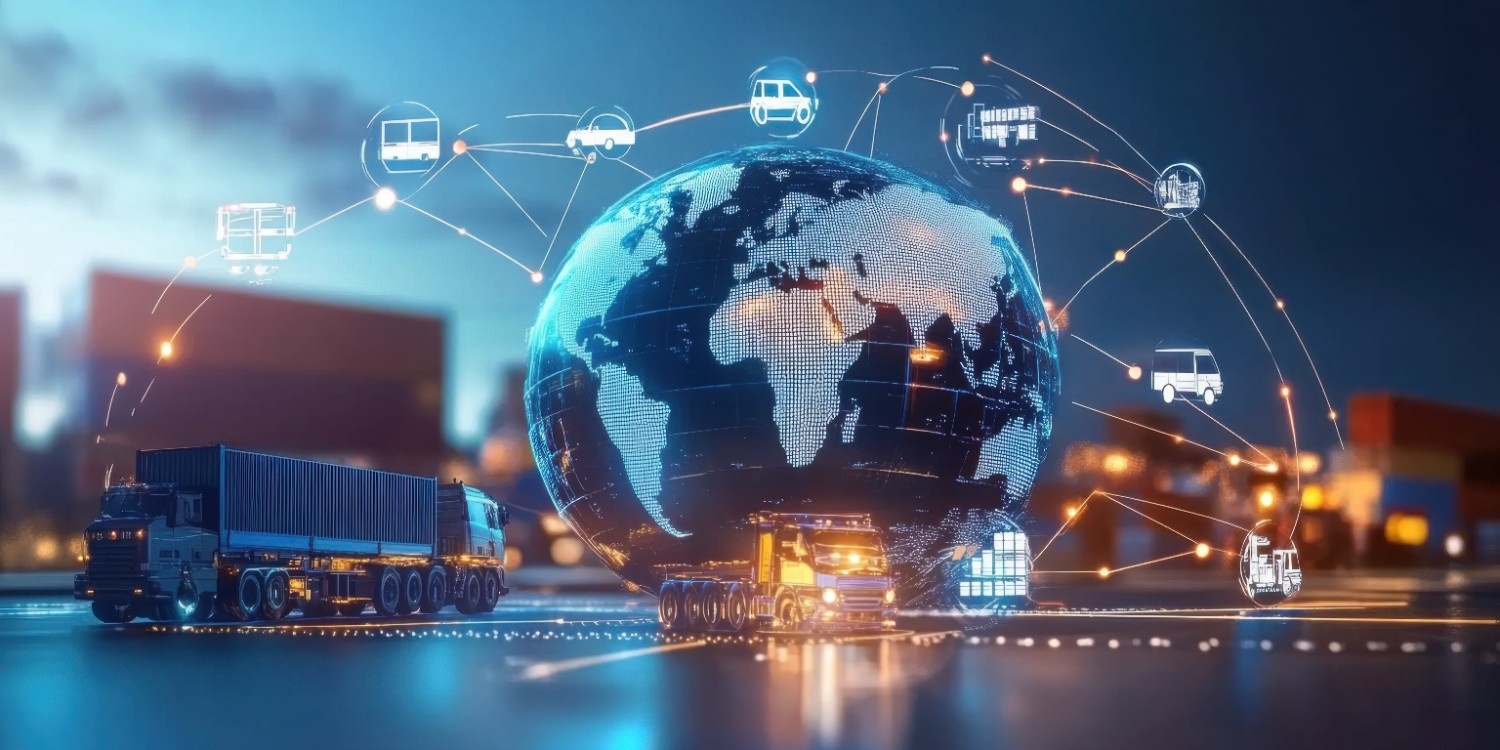
Consider it a moment: even that shirt you are wearing must have travelled as far as most of the people in the whole world in the short span of a few centuries. It is unbelievable when you put it in proportion. The evolution of humanity has seen a phenomenal change in how people used to travel in the old caravans filled with dusty roads to its current form of global supply chains that are hyper-connected. It continues to change as we speak in 2025.

The Antique Origins of the Contemporary Logistics
We can go back to the beginning. The Silk Road was not a route but a complex network of roads, built in the Han Dynasty of China circa 130 BCE, that stretched for more than 6400 kilometers. The task of the traders was out of this world; deserts, mountains, and the weather were so unfair. They could not simply draw out their smartphones and monitor the condition or their shipments. They instead relied on prudent route planning and the system of caravanserais, which were more like warehouses and rest stops combined, the first of their kind in the world.
What was so basic to these ancient traders that still makes logistics run: efficiency matters. Their routes were selected wisely, inventory was well managed to maximize profits, and their transportation strategies varied depending on the terrain. Sound familiar? The current logistics managers are essentially doing exactly that, but using AI and real-time data as the basis rather than intuition and experience.
The Maritime Silk Road later replaced the overland routes; it carries more cargo, costs less, and takes less time to pass through. The invention of this land-sea transition was the first great logistics optimization in human history, proving that industry has always been permeated by innovation.
The Game Changers: Containerization and Industrialization
Go far into the 20th century and logistics had the so-called ‘iPhone moment’. Everything changed in 1956 when Malcolm McLean loaded 58 standardized containers onto an oil tanker that had been converted into an Ideal X. Prior to this, cargo handling was agonizingly inefficient: the goods were disassembled, loaded item by item, and then assembled at the point of destination. It was cumbersome, time consuming, and absolutely a nightmare in terms of logistics.
Containerization transformed the picture. McLean invented what is today known as intermodal transportation by ensuring a uniformity of movement of goods between ships, trucks, and trains. The modern container vessels have the capacity of more than 20,000 twenty-foot equivalent units, or TEUs, which makes them floating cities of commerce. That is more than what most individuals would have ever thought in the 1950s inbound logistics.

The Digital Revolution that will transform Logistics in 2025
This is where the fire starts burning. We are currently experiencing another tremendous change. By 2024 the total global logistics market had access to $5.65 trillion and it is estimated to grow to $8.07 trillion by 2033 at a steady year by year growth rate of 4.02. However, it is no longer about size. It’s about intelligence.
The way logistics functions are radically altering due to artificial intelligence. According to recent industry data, AI implementation in the logistics industry is set to reduce operational costs by one-third and increase delivery efficiency by one-fourth. Businesses are not simply transporting goods at a quicker pace; they are anticipating breakdowns ahead of time, smoothing pathways in real time, and deciding on the course of action that would have otherwise taken humans days to figure out.
Here are these figures: early AI adopters are experiencing a 15 saved on logistics, 35 saved on inventory, and 65 saved on service. They are not incremental improvements. They’re revolutionary.
The Contemporary Logistics Environment
We are experiencing the making of logistics global and instant in 2025. Real time visibility has ceased to be luxurious but it is a new standard. Customers desire precise tracking of their packages at any given time, and businesses require such visibility to operate increasingly complex supply chains.
The e-commerce logistics market is projected to go beyond 535 billion alone this year. That we grow impatient, all of us, truthfully. We do not simply desire things; we desire things immediately. Same-day delivery has become the norm in most markets, and the U.S. same-day delivery market is estimated to cross $13 billion in 2025.
However, this is where there is one more thing that is not discussed frequently: sustainability is now part of logistics, not a by-product. Firms are switching to electric vehicles, exploring alternative energy sources such as hydrogen, and re-engineering their packaging to minimize environmental impact. 62% of the remote workers exclusively purchase businesses that protect the environment. Logistics is responding to the market’s demand for change
The Implications of this Evolution to the Future
The process of moving between the previous supply chains of the old trade routes to the modern supply chains with the use of AI is demonstrating something significant to us: logistics has always been about finding solutions to problems in a creative way. It could be the safest of paths around the Himalayas or machine learning to tell the shipping about the impending delay nine days later, the task is the same. Move goods effectively, consistently and more sustainably.
In the future, self-driving cars, the digital twins to represent complete supply chains, and even more advanced artificial intelligence systems will continue to push the limits. The logistics business is not decelerating. On the contrary, it is accelerating.
Next time you place an order online and it comes the following day, keep in mind: you are playing with the system that has taken thousands of years to develop, and is continuing to develop on a daily basis. Quite an impressive thing to consider.